I AM A GAMES DESIGNER!
Will you Fail Sometimes?
Answer: Yes, yes you will. You will fail again, again and again, and you will fail many more times and that is when you will succeed; Jesse Shell is saying so that we can learn from are mistakes, making sure will learn from those mistakes.
"Each failure brings you a step closer to a Truly phenomenal game".
- Jesse Shell
"If you aren't falling, you aren't trying hard enough and you aren't really a game designer".
- Jesse Shell
The most Important Skill for a game designer is Listening. Listening is a huge part of being a Games Designer, it applies to yourself and the client.
- Listen to the Client: The Client is the one that will be paying you and if you don't give them what they want, they will find someone's else who can do the job. So always listen to the Client and give them what they want even if it a ridiculous idea.
- Listen to Yourself: If you can listen to Yourself it can become the most powerful tool in Games Design, it is the secrets behind your tremendous creativity.
Tuesday, 27 November 2012

Sunday, 25 November 2012
Caillois Terminology Notes
Caillois Terminology in Roger
Caillois: Man, Play and Games
Cailois Divides play into four main categories:
• Alea/(Chance)
• Ilinx/(Vertigo)
• Agon/(Competition)
• Mimicry/(Simulation)
And alongside the four categories is the
directions of Ludas and Paidia:
• Paidia: Paidia is an emphasis on playfulness.
• Ludas: Ludas means an emphasis on rules.
The four categories aren't meant as
exclusive and inseparable. Collois gives examples of many types of hybrids
between the categories. They are well thought of as elemental they are not
components, but they dimensions of any given game or form of play.
• Alea: Alea
describes the element of chance, in the game chance creates the outcome.
• Ilinx: Ilinx
is discribed by Caliois by topic that doesn't nearly have as much attention as
the other categories that Caillois described.
• Agon: Agon
is the copetitive nature of play, agon depends on competition
and opposition such as sport.
• Mimicry:
Mimicry is the developing side of games. Mimicry is is another to participate
within the illusory world.
• Paidia: Paidia
is the freedom within gameplay of basic levels, the freedom and rules have a
relationship because the gameplay is depending on the rules of the game but
simultaneously it is about the freedom from the rules.
• Ludas: Ludas
is a desire to find amusement in obstacles, that leads to the sense of what
games are but the definition alone does not imply it.
Thursday, 22 November 2012
Games Britannia - Dicing with Destiny
Games Britannia is a TV documentary presented by Benjamin Woolley. Through the show Benjamin explores popular games in Britain from old to new and explores the social and history behind the games we play today.
The documentary begins with Benjamin talking about the archaeological dig where a body was found in a grave and there laid an already set board game among with other relics we now know as Alea Evangelii. We are not sure why this person was buried with the game but we can say that the person must have been important such as the creator of the game itself.
The Documentary then moves on to the works of Dr. Irving Finkel the Assistant Keeper of Ancient Mesopotamian. Who then talks about the game, he talks about the possibilities of the games rules which are only guessed not actual rules of the games. When I say 'guessed' I mean it by the rules are unknown and from hard work research they have came to these rules.
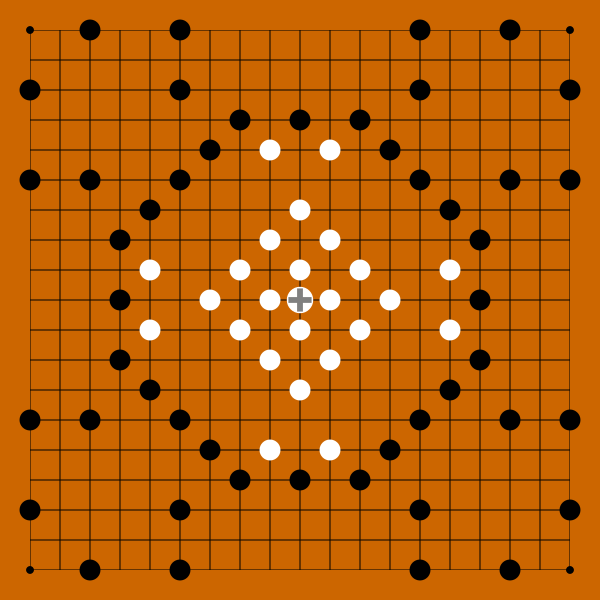
Looking into the game mechanics and how it's rules.
- The game board consists of 19 x 19 squares shown in the image below.
- A player will have more number of pieces than the other.
- The game starts with black counters, so the player who starting with the black counters will move one of their pieces on his/her turn.
- Pieces can not move through or onto an occupied intersection, but the King piece can only move through or onto the castles and citadels.
- Capturing pieces can only be done when the enemies pieces are surrounding on two opposite sides of the players counter. Kings cannot capture enemy pieces.
- The King can only be captured when the enemy pieces are surrounding with all four sides of the King, the King can also be captured with three pieces when the King is in a corner of the board.
- To win the game the player with the black counters have to capture the King where as the player with the white counters can only win when the King has reached the corner.
- Capturing pieces can only be done when the enemies pieces are surrounding on two opposite sides of the players counter. Kings cannot capture enemy pieces.
- The King can only be captured when the enemy pieces are surrounding with all four sides of the King, the King can also be captured with three pieces when the King is in a corner of the board.
- To win the game the player with the black counters have to capture the King where as the player with the white counters can only win when the King has reached the corner.
Subscribe to:
Posts (Atom)